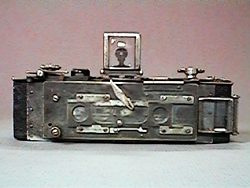
| Camera
Type |
35 mm viewfinder
stereo camera |
| Manufacturer |
Jules
Richard, Paris, France |
| Year
Introduced |
About 1920 |
| Film |
35 mm movie
film |
| Size |
193
x 84 x 60 mm (W x H x D) |
| Weight |
688 grams |
| Lens
Separation |
56.90
mm |
| Image
Format |
18.32
x 23.70 mm (W x H) |
| Image
Window Separation |
58.14
mm |
| Lenses |
Krauss
Tessar, 1:4.5/28 mm, glass |
| Diaphragms |
Pinhole diaphragms
between the lenses, f/4.5, f/6.3, f/8, f/10 and f/20 |
| Focusing |
Fixed focus.
Accessory lenses 0.5 m |
| Shutter |
Mechanical
guillotine type shutter, pneumatically controlled, in front of the lenses.
Cocked with lever. |
| Shutter
Speeds |
Continuously
adjustable from 1/400 to 1/5 sec. and "T" |
| Viewfinder |
Two
Newton viewfinders (approx. 0,7x) |
| Rangefinder |
n/a |
| Film
Loading |
Manual |
| Film
Transport |
Manual, with
knob. By 8 sprocket holes (= 38.00 mm), sprocket wheels on top and bottom. |
| Film
Rewinding |
n/a. Film
is transported from one brass spool to another. |
| Frame
Counter |
Additive,
0 to 25. Manual reset. |
| Flash
Contact |
n/a |
| Tripod
Socket |
7.5
mm hole |
| Selftimer |
n/a |
| Special
Features |
Cable Release
Socket, close-up lenses (0.5 m) can be slid in front of the lenses |
| Accessories |
carrying case |
| Notes |
The
camera is the first camera to use 35 mm film and the first to use the "Colardeau
Progression" (film transport by two image widths) |