
| Projection of Stereo Movies |
Stereo movies can be projected using numerous systems.
Anaglyph projection
Some oler stereo movies used the anaglyph projection technology, which was no real success. In the 1980's, quite a few stereo movies were shown on TV using the anaglyph system.
Polarization
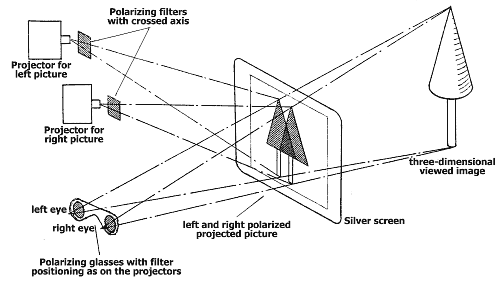
There are two different varieties of polarized stereo projection: linear and circular. Basically, polarized projection of 3D slides or movies involves:
1. Use of a dual-lens projector, or two single-lens projectors.
2. Polarized filters over each projection lens are aligned at right angles
3. Use an aluminum (silver) or lenticular screen, not a white one. A white screen will de-polarize the light projected, destroying the stereo effect. The silver or lenticular silver screens preserve the polarization of the projected light. However, not all silver screens are suitable for stereo projection!
4. Polarized glasses are worn which match the alignment of the projector lens polarizing filters.
Linear polarization
The majority of movies produced between the 1950's and 1990's used linear polarization. In most projectors and glasses using linear polarization, the orientations of the polarization is in a "V" shape.
Circular polarization
Most current digital movie projection systems, such as Real-D™, use circular polarization and only one digital projector.
Raster Screens
Raster screens (lenticular)
Lenticular raster screens never got beyond an experimental stage in stereo projection.
Raster screens (barrier-strip)
Barrier-strip screens were used in the 1940's and 1950's in movie theaters in the Soviet Union and France. The Soviet system, invented by Iwanov, consisted of a metal frame and vertically attached metal wires. The French used a rotating metal drum, called the "Cyclorama". Due to their high weight of more than one ton, both systems were no success.
Field-sequential
Field-sequential projection displays left and right eye views alternating on the screen. Shutters, mostly with LCDs, block the view of the eye who's image is currently not shown on the screen. Early systems used mechanical shutters, either rotating discs, rotating drums or shutters operated by electromagnets. Al systems have to be synchronized with the projector.
Pulfrich
Pulfrich projection only works with moving images, where a camera hast to move horizontally to obtain the necessary parallax.
Infitec
The Infitec system uses interference filters
 |
|
|

 |
Back to the Stereoscopy.com FAQ Page |
